2026 Governance Wakeup Call:
Investors must push for foresight and accountability in Japan’s stagnant giant boards (MUFG, SMBC, Mizuho, Mitsubishi, Sumitomo, and Mitsui Corporation)
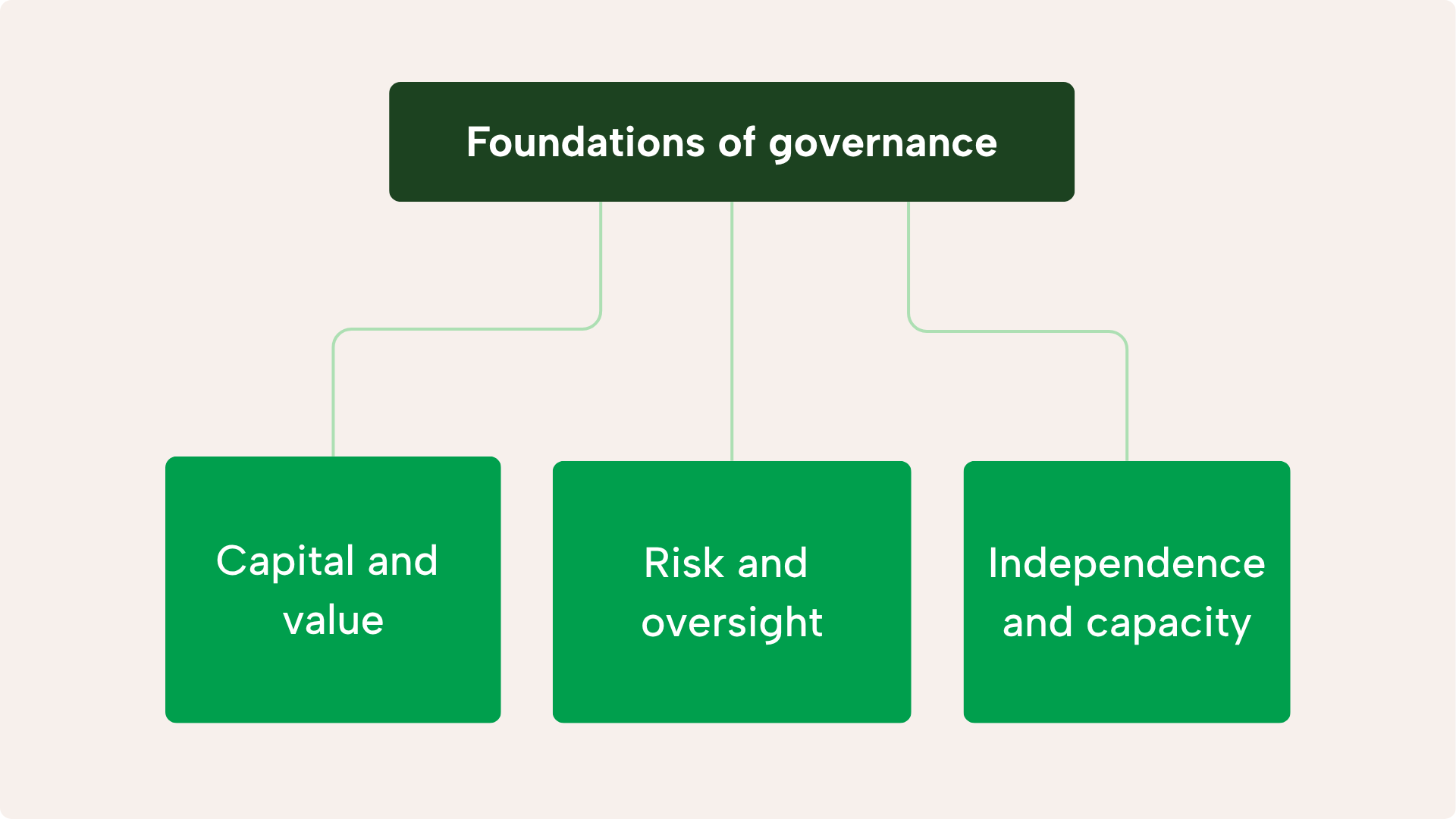
Foundations of governance
To ensure governance is operating effectively, boards of directors must provide independent, technically competent oversight of material risks while actively managing capital efficiency to drive transparent, long-term corporate value.
- Capital & Value: Fiduciary duty is demonstrated to enhance long-term corporate value through disciplined resource allocation, sustainability-driven growth, and rigorous assessment of cross-shareholdings.
- Risk & Oversight: Directors must integrate technically competent oversight into long-term strategic decisions, with clear board-level responsibility, and provide transparent evidence of their accountability.
- Independence & Capacity: Board integrity is maintained by excluding conflicted or “overboarded” directors to ensure focused, impartial supervision.
What is governance?
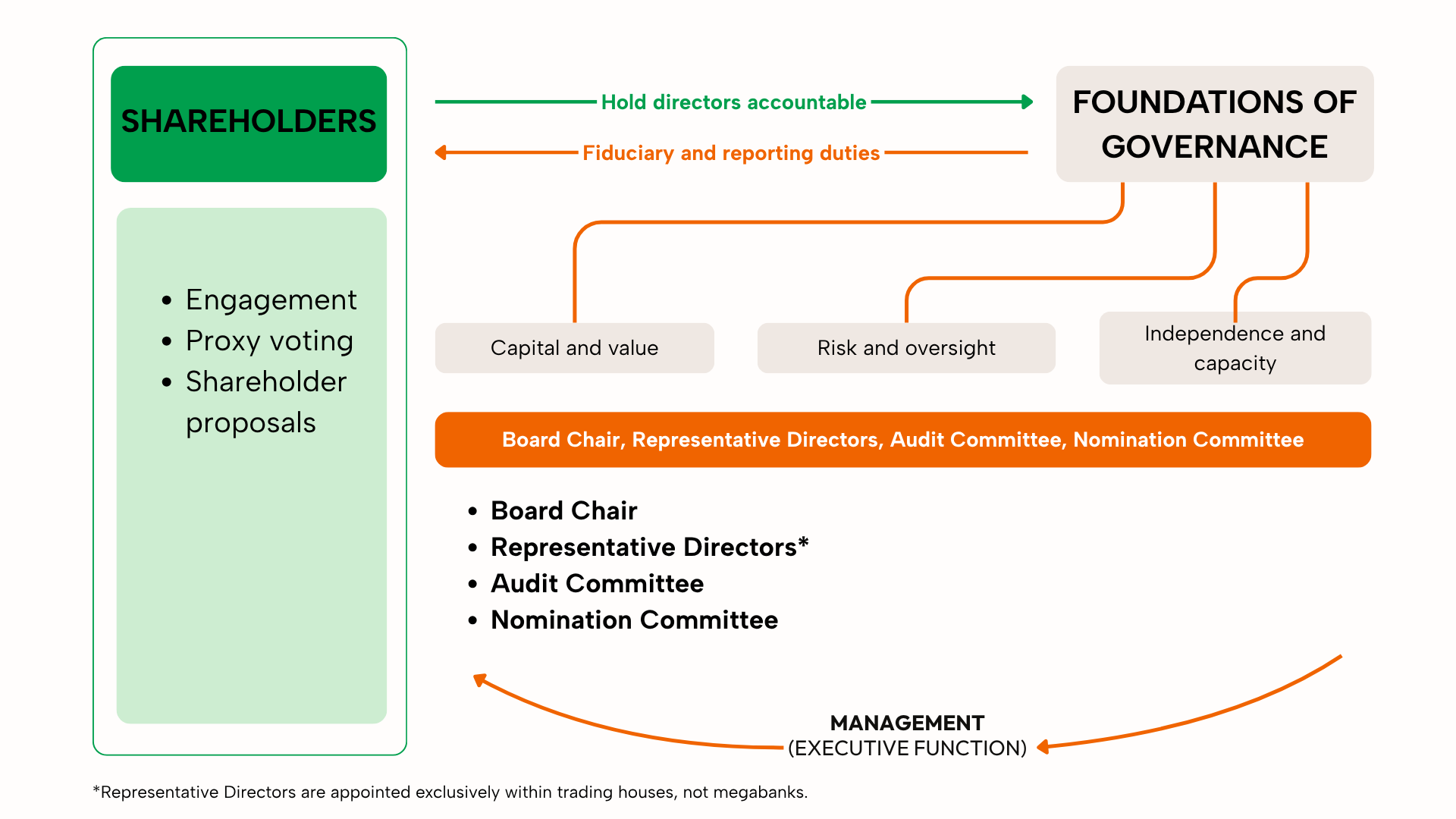
Quite simply, corporate governance is the framework of rules, relationships, and processes by which a company is directed and held accountable to ensure it operates ethically, transparently, and in the best interests of its shareholders and stakeholders.
In Japan, processes are set under Companies Act and the Corporate Governance Code with companies also creating functions under their articles of incorporation and bylaws.
The following functions are typical in a company:
Why the focus on governance?
Good governance is critical to maintaining long-term corporate value.
Our past shareholder proposals have consistently highlighted the importance of board accountability and transparent governance for risk management and to enhance long-term corporate value.
Governance and transparency matter to investors.
- Board competency: Investors expect the Board to possess the expertise necessary to oversee and manage risks, which are material to corporate strategy and financial performance.
- Board and Audit Committee’s risk oversight: Investors expect the Board to oversee executives. The Auditors are expected to audit the Board's execution of duties.
What questions should investors be asking directors?
See table - these questions are adapted from multiple sources, including World Economic Forum Climate Change Governance Principles, CA100+, IIGCC, Japan’s Corporate Governance Code, as well as the proxy voting guidelines of multiple global and Japanese asset managers.
| Topic | Questions | Who should be responsible |
| Risk & Oversight | 1.a. Does the Board effectively oversee the identification, assessment, and management of the company's short-, medium-, and long-term material risks and opportunities? | Chairs of the Boards, Representative Directors, Auditors, Chairs of the Audit Committees |
| a.i. Does the Board ensure that management conducts ongoing assessments of the short-, medium-, and long-term material risks and opportunities? | Same as the above. | |
| a.ii. Does the board ensure that the company’s growth plans and strategic and operational decisions are proportionate to the recognition of the materiality and financial impact of these risks? | Same as the above. | |
| a.iii. Does the company publicly disclose comprehensive evidence of the Board's or Board-level Committee oversight of the management of material risks? | Same as the above. | |
| b. Does the company’s governance structure clearly designate board-level responsibility for the oversight of material financial risks and opportunities? | Chairs of the Boards and CEO, or Chairs of the Audit Committees | |
| c. Do the Board and Auditors collectively possess the necessary skills, expertise, and experience (collectively “competency”) to oversee the emerging risks the company identified? | CEO and Chairs of the Nomination Committees | |
| c.i. Has the company assessed these individuals’ competencies with respect to managing material risks and disclosed the results of those assessments, including details on the criteria used? | Same as the above. | |
| d. Do the Auditors and relevant Board-level Committees exercise independent oversight of risk management and internal controls, separate from management? | Chairs of the Audit and Supervisory Committees and Auditors, Chairs of the Audit Committees | |
| d.i. Has the company disclosed auditing results and methodologies, including the criteria for the oversight of risk controls with respect to identified material issues? | Same as the above. | |
| e. Has the company experienced material governance failures or major scandals that appear attributable to inadequate board oversight and ineffective risk management? | Candidates deemed to bear responsibility for or to have been involved in such misconduct. Chairs and Members of the Audit and Supervisory Committees and Auditors, Chairs of the Audit Committees | |
| e.i. Has the Board or relevant Board-level Committees ensured appropriate responses and future prevention measures? | Representative Directors, Chairs of Audit Committees, Members of the Audit and Supervisory Committees and Auditors | |
| Capital & Value | 2. Has the Board demonstrated that directors are fulfilling their fiduciary duties and accountability to shareholders by promoting sustainable corporate growth, enhancing medium- to long-term corporate value? | Chairs of the Boards, Representative Directors, Chairs of the Audit Committees |
| a. Does the Board maintain a clear, credible, and publicly disclosed policy on cross-shareholdings, including an explicit policy regarding their reduction? | Chairs of the Boards, Representative Directors | |
| a.i. Does the Board annually assess each individual cross-shareholding by examining whether its purpose remains appropriate and whether the benefits and risks associated with the holding are justified relative to the company’s capital efficiency, and does the company disclose the results of that assessment? | Chairs of the Boards, Representative Directors, Auditors, Chairs of the Audit Committees | |
| b. Does the board ensure the development of a basic policy for the company's sustainability initiatives from the perspective of increasing corporate value over the mid- to long- term? | Same as above. | |
| Independence & Capacity | 3. Are board members independent in respect of other directorships (Investors’ proxy voting guidelines, Japan CGC etc)? | CEO and Chairs of the Nomination Committees |
What should investors do if they’re not satisfied with directors’ responses?
Vote no for the director - it is the main power that investors can exercise to show dissatisfaction and call for directors to wake up and improve governance.